


Seeing a strange term like python 54axhg5 can stop you in your tracks. It looks like a version, a bug code, or even a hidden feature. But nothing in official Python releases such as 3.14.4 or 3.13.13 matches this format.
Many developers first notice it inside logs, build artifacts, or CI/CD pipelines. That is where the confusion starts. The string feels technical, yet it does not appear in official documentation, package registry, or any trusted release naming conventions.
So, what is really going on here? Is it a python software issue 54axhg5, a real bug, or just a random alphanumeric identifier? The answer is simpler than it seems, and understanding it can save hours of debugging.
What Is python 54axhg5?
The term python 54axhg5 often creates confusion because it looks technical and official. Many assume it is a version, error code, or hidden feature. In reality, it is none of the above.
What python 54axhg5 Actually Means?
- It is not part of official Python releases like 3.14.4 or 3.13.13
- It is not listed in any official documentation or package registry
- It is usually a random alphanumeric identifier generated by systems
You may see it inside logs, CI/CD pipelines, or build artifacts. These systems often create unique labels to track processes or failures.
Why It Appears in Python Environments?
In most cases, python software issue 54axhg5 is linked to external systems, not Python itself. It acts as an internal identifier rather than a real error. Understanding this helps you avoid chasing the wrong problem and focus on actual debugging.
Is python 54axhg5 a Real Python Error or Version?
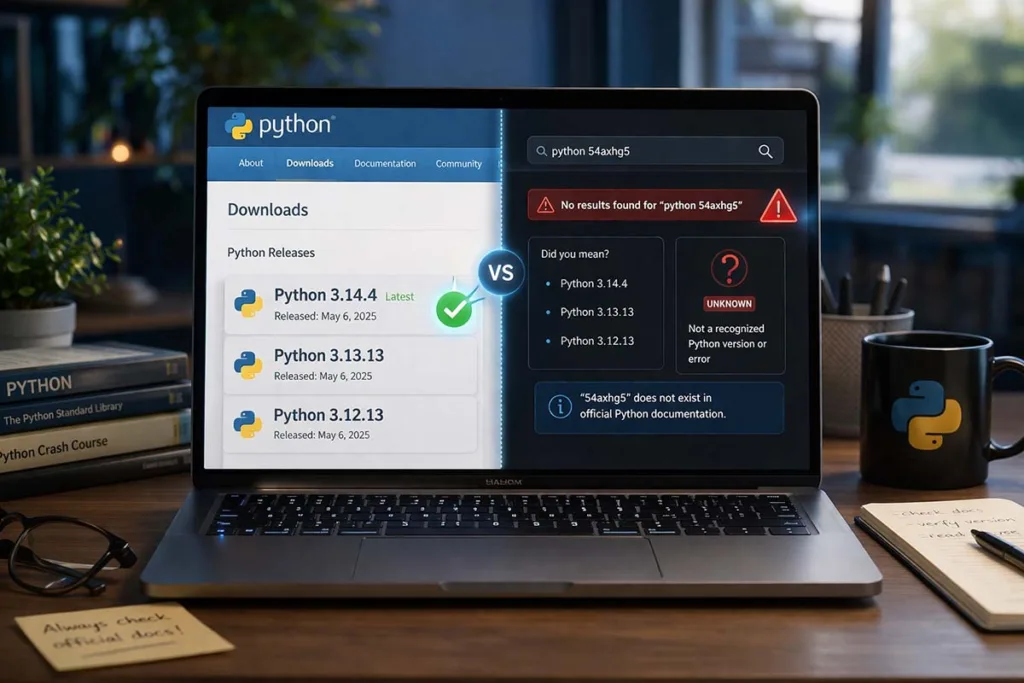
This is where most confusion begins. The term looks official, so many assume it belongs to Python itself. But once you check trusted sources, the picture becomes clear.
Python Uses Standard Versioning
Python follows clear release naming conventions based on numbers, not random strings. Every version is documented in official documentation and tracked through Python releases.
Examples include:
- 3.14.4
- 3.13.13
- 3.12.13
There is no record of anything like python 54axhg5 in the package registry or release notes.
Why It Feels Like a Real Error?
The confusion comes from misleading content online. Some guides mention fake commands, modules, or performance claims tied to this term. In reality, it does not exist as a real version or error.
Instead, it behaves like an internal identifier or placeholder string. Understanding this difference prevents wasted time and helps you focus on real debugging issues inside your code or environment.
Why You Are Seeing python 54axhg5?
Seeing python 54axhg5 usually points to something happening behind the scenes, not inside Python itself. The term often shows up when systems try to label or track an issue. Understanding the root causes helps you avoid confusion and focus on the real problem.
Internal Identifiers and System Labels
Many modern systems generate random alphanumeric strings to track processes. These appear in CI/CD pipelines, build artifacts, and deployment logs.
- Used as internal identifiers
- Created automatically during builds
- Help trace failures across systems
This is one of the most common reasons you see this term.
Python Bug 54axhg5 Confusion
Users often assume it is a python bug 54axhg5. That assumption comes from how it looks. In reality, it is not a real bug code.
It usually comes from external tools or services connected to your Python project.
Environment and Dependency Issues
Sometimes, a python software issue 54axhg5 appears due to environment problems.
- Broken virtual environments
- Missing or conflicting packages
- Incorrect dependency versions
These issues trigger errors, and systems attach identifiers to track them.
Concurrency and Runtime Failures
Complex apps introduce risks. Async operations, thread conflicts, and runtime behavior issues can fail silently. When that happens, systems may log a label instead of a full error, leading to confusing outputs like this.
Common Symptoms (54axhg5 Failed to Load & More)
When python 54axhg5 appears, it rarely comes with a clear explanation. That is what makes it frustrating. Instead of a detailed error, you often see vague signals that point to deeper issues.
Typical Signs You Might Notice
The most common symptom is the message 54axhg5 failed to load. It often shows up inside logs or deployment logs without a proper traceback.
You may also notice:
- No clear traceback or error message
- Sudden silent failure during execution
- Code works locally but fails in production environment
- Random crashes linked to runtime behavior
- Systems showing only an internal identifier instead of details
Why These Symptoms Matter?
These signs usually indicate missing debugging signals. The system hides the real issue behind a label.
If you see problem on computer 54axhg5, it often points to environment, dependency, or system-level failures, not a direct Python error.
Real Python Issues People Confuse with python 54axhg5
The label python 54axhg5 often sends people in the wrong direction. What they are actually seeing is usually a normal Python problem wrapped in weak logs, poor traceback output, or a confusing internal identifier. Knowing the real issues behind it makes debugging much faster.
Mutable Default Arguments
A shared default list or dict can create strange bugs. This kind of hidden shared state changes behavior across function calls and makes the issue feel random.
Late Binding Closures
Functions created inside loops may capture the wrong value. That leads to confusing output and is often mistaken for a mysterious runtime error.
Dependency Conflicts
Mismatched packages inside virtual environments can break imports or trigger unstable behavior. In many cases, the real cause is a dependency issue, not python 54axhg5 itself.
Async and Threading Problems
Bugs in async operations or threads are hard to track. Race conditions, timing issues, and memory pressure can look like a ghost bug when the code fails under load.
Missing or Hidden Tracebacks
Poor debugging workflow hides useful details. When deployment logs or monitoring tools show only a label, developers may think python bug 54axhg5 is real, even though the real failure sits deeper in the codebase or environment.
Step-by-Step Fix for python 54axhg5 Issues

Fixing python 54axhg5 starts with shifting your mindset. You are not fixing a Python error. You are tracking a hidden issue behind a vague label. A structured approach makes the process much easier.
Step 1 – Check Logs and Tracebacks
Start with visibility. Open your logs and look for missing traceback details.
- Enable debug mode
- Inspect deployment logs and system output
- Look for hidden runtime behavior clues
This step often reveals the real failure behind the label.
Step 2 – Verify Python Environment
Next, confirm your setup is correct.
- Check Python version like 3.14.4 or 3.13.13
- Validate virtual environments
- Ensure correct environment variables
Misconfigured environments are a common cause of a python software issue 54axhg5.
Step 3 – Fix Dependencies
Dependency problems break applications silently.
- Reinstall packages from requirements.txt
- Check for version conflicts
- Clean unused libraries
This step helps eliminate hidden dependency issues.
Step 4 – Reproduce the Issue Locally
Try to isolate the problem outside complex systems.
- Run code without containers or CI/CD pipelines
- Remove automation layers
- Test in a simple local setup
Reproduction gives you control and clarity.
Step 5 – Simplify and Test Code
Now focus on your codebase.
- Reduce complexity
- Remove shared state
- Test small modules individually
This is where most bug 54axhg5 fix scenarios are resolved by identifying the real underlying issue.
How to Verify If python 54axhg5 Is Safe or Fake?
Not every technical-looking term is real. python 54axhg5 often appears convincing, which is why verification matters. A quick check can save hours of confusion and prevent chasing false leads.
Check Official Sources First
Start with trusted references.
- Visit official documentation and review Python releases
- Look for versions like 3.14.4 or 3.13.13
- Search the package registry for any matching module
If the term does not appear there, it is not an official Python component.
Inspect Your Codebase and Logs
Next, trace where it comes from.
- Search your codebase for the string
- Review logs and deployment logs
- Check for internal identifier usage
Often, it is generated inside tools or scripts.
Understand the Difference
A real Python error shows clear traceback and context. A fake or external label does not.
This simple source validation step helps you confirm whether you are dealing with a real issue or just a misleading system-generated string.
Common Myths About python 54axhg5 (Debunked)

There is a lot of confusion around python 54axhg5. Many articles present it as something official or advanced. That is where the problem starts. Let’s clear the biggest myths one by one.
Myth 1 – It Is a New Python Version
Some claim it is a new release. That is not true. Real Python releases follow numeric formats like 3.14.4 and 3.13.13. There is no such version in official documentation.
Myth 2 – It Is a Security Module
You may see claims about encryption or advanced features. These are misleading. There is no module with this name in any package registry or standard library.
Myth 3 – It Has Special Commands
Some guides list fake commands or tools. These do not exist. They are part of a misleading tutorial trend that confuses developers instead of helping them.
Prevention Tips to Avoid python 54axhg5 Confusion
Avoiding confusion around python 54axhg5 is easier than fixing it later. A few simple practices can keep your workflow clean and your debugging process clear.
Follow a Clean Debugging Workflow
Good habits make a big difference.
- Always enable detailed logs and traceback output
- Use a consistent debugging workflow across projects
- Monitor errors through a reliable monitoring system
Clear visibility prevents misinterpretation.
Manage Environments and Dependencies
Unstable setups often create misleading issues.
- Maintain clean virtual environments
- Lock dependencies with version control
- Avoid unnecessary package changes
This reduces hidden conflicts.
Use Clear Naming and Documentation
Random labels create confusion.
- Avoid vague internal identifiers
- Document CI/CD pipelines and build steps
- Keep project notes updated
Clarity helps you quickly separate real issues from misleading system-generated strings.
FAQ Section
What is python 54axhg5?
Python 54axhg5 is not an official Python version or error. It is usually a random alphanumeric identifier created by systems. You may see it in logs, CI/CD pipelines, or deployment logs, but it does not exist in official documentation.
Is python 54axhg5 dangerous?
No, it is not dangerous by itself. It is only a label. The real concern is the underlying issue causing it. Focus on traceback, runtime behavior, and system-level errors to find the root problem.
Why does 54axhg5 failed to load appear?
The message 54axhg5 failed to load usually appears when systems cannot show full error details. It often relates to environment issues, missing dependencies, or hidden failures in virtual environments.
How do I fix python bug 54axhg5?
Start with logs and enable debugging. Verify your Python setup, such as 3.14.4 or 3.13.13. Then fix dependency issues, test locally, and follow a clear debugging workflow to resolve the actual problem.
Conclusion
By now, the confusion around python 54axhg5 should be clear. It is not a real version, not a documented error, and not part of official Python releases like 3.14.4 or 3.13.13. Instead, it is usually a random alphanumeric identifier created by systems.
What matters is what sits behind it. Most cases link to hidden issues in logs, missing traceback, or unstable virtual environments. That is where your focus should be.
A smart approach always wins. Use a clean debugging workflow, verify sources through official documentation, and track problems using reliable deployment logs.
Once you stop chasing the label and start analyzing the real signals, fixing these issues becomes much faster and far less frustrating.